

Environmental Management: Reducing Barking by Changing the Environment, Not the Dog
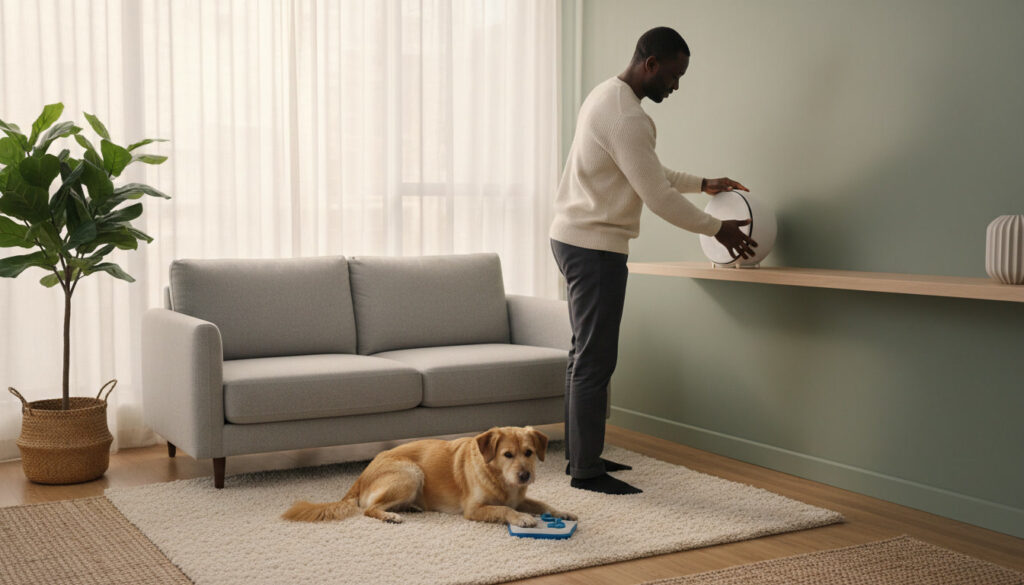
Environmental management is one of the fastest, simplest ways to reduce barking — often immediately. Instead of trying to train your dog in difficult or overwhelming situations, you adjust the environment so barking is less likely to happen in the first place.
Management doesn’t replace training.
But it creates the calm, predictable conditions your dog needs to learn.
For many households, small environmental tweaks can cut barking in half before any formal training even begins. That’s why behaviorists often start with management first — it reduces stress for both you and your dog instantly.
What Is Environmental Management?
Environmental management means modifying the dog’s surroundings to:
- Reduce exposure to triggers
- Lower arousal
- Minimize overstimulation
- Create calm, stable routines
- Prevent barking before it starts
For example:
- Closing blinds
- Using white noise
- Adding gates or barriers
- Increasing enrichment
- Adjusting walk routes
- Setting up a quiet resting space
Management helps dogs succeed by removing situations they’re not ready to handle.
Why Environmental Management Works So Well
Most barking happens because dogs are:
- Bored
- Overstimulated
- Frustrated
- Overaroused
- Under-exercised
- Exposed to triggers they can’t handle
- Put in situations beyond their learning threshold
Environmental management:
✔ Removes or softens the trigger
Less barking simply because there’s less to react to.
✔ Keeps the dog under threshold
Training is only effective when the dog is calm enough to learn.
✔ Lowers stress
Calmer dogs bark less, learn faster, and recover more quickly.
✔ Gives structure
Dogs thrive on predictable patterns.
✔ Reduces rehearsal of “bad” habits
If barking doesn’t happen, it doesn’t get reinforced.
This method works for every dog, regardless of age, breed, or behavioral history.
How to Use Environmental Management Step by Step
Below are the most effective management strategies, grouped by common barking triggers.
⭐ 1. Visual Management (Window Barking)
Dogs who bark at:
- People walking by
- Cars
- Dogs
- Squirrels
- Street activity
…often benefit from reducing visual access.
Tools & strategies:
- Close the blinds or curtains during high-traffic times
- Use window film to blur the lower half of windows
- Block access to overstimulating windows
- Rearrange furniture so the dog can’t sit right at the glass
- Use baby gates to keep the dog out of certain rooms
This reduces alert barking dramatically.
⭐ 2. Sound Management (Noise Sensitivity)
Dogs who bark at:
- Doorbells
- Knocks
- UPS trucks
- Garage doors
- Neighbors
- Apartment hallway sounds
…benefit from sound buffering.
Helpful tools:
- White noise machines
- Fans
- Soft music (classical and spa music work well)
- Noise-canceling curtains
- Closing interior doors
- Playing soundscapes during busy hours
Less noise → less reactivity → less barking.
⭐ 3. Barrier Management (Territorial Barking)
Territorial dogs react to:
- The front door
- Yard boundaries
- Fences
- Gates
- Property lines
Reducing access helps the dog feel less responsible for “guard duty.”
Simple solutions:
- Use baby gates to block access to the entryway
- Create distance from the front door
- Use exercise pens to limit roaming
- Keep dogs away from fences where visual triggers pass by
Removing “guard posts” calms territorial dogs significantly.
⭐ 4. Routine Management (Predictability Reduces Barking)
Dogs bark less when they know what to expect.
Build predictable routines:
- Set consistent meal times
- Regular walks
- Daily play sessions
- Predictable rest periods
- Structured alone time
- Clear pre-walk cues
A predictable dog is a quiet dog.
⭐ 5. Enrichment Management (Boredom Barking)
Bored dogs bark.
Enrichment gives them something better to do.
Provide:
- Puzzle toys
- Snuffle mats
- Frozen Kongs
- Long-lasting chews
- Training games
- Scent work
- Cardboard destruction boxes
- Slow feeders
Mental stimulation reduces excess energy, frustration, and attention-seeking barking.
⭐ 6. Exercise Management (Energy Outlet Control)
A dog who has enough physical exercise is less reactive, less hypervigilant, and more content.
Ideal exercise types:
- Daily walks (structured, not frantic)
- Fetch
- Tug games
- Off-leash play (if appropriate)
- Treadmill (for high-energy breeds)
- Nose walks (sniffing releases serotonin)
Physical and mental exercise together produce the best results.
⭐ 7. Space Management (Calming Zones)
Create a designated quiet, restful area for your dog where nothing stressful happens.
This may include:
- A calm corner
- A crate (if trained positively)
- A covered bed
- A cozy mat
- A quiet room with soft lighting
- A spot away from traffic and doorways
This “safe zone” helps dogs self-regulate barking impulses.
⭐ 8. People & Visitor Management
Before training can take effect, your dog may need:
- Visitors to enter calmly
- Pre-arranged “settle on mat” time
- Treats ready for greetings
- Guests to avoid leaning over or overexciting the dog
- A gate or barrier during the first minute or two of arrival
Visitors are a huge trigger — management makes greetings smoother.
What Environmental Management Looks Like in Real Life
Example: Dog Barks at Every Movement Outside Their Window
- Apply frosted window film
- Move couch away from the window
- Add white noise during peak activity hours
- Provide a snuffle mat to occupy the dog
- Barking drops dramatically
Example: Dog Barks Every Time You Leave the House
- Give a frozen Kong 3 minutes before departure
- Close blinds
- Turn on calming music
- Keep goodbye routine low-key
- Dog is calmer and more settled
Example: Dog Barks at Doorbell
- Play white noise
- Add a barrier gate
- Cue “go to mat” (later, during training phase)
- Practice with controlled DS/CC sessions
- Dog learns to stay calmer during real doorbell events
Quick Tips for Better Management
- Use management BEFORE behavioral triggers, not after
- Combine it with training for long-term success
- Keep solutions simple at first
- Test different tools to see which reduce arousal most
- Avoid overwhelming your dog with too many changes at once
- Use management as a “first line” for new or rescued dogs
Common Management Mistakes
❌ Expecting management alone to “cure” barking
It’s a support tool, not a training method.
❌ Being inconsistent
If the blinds are open sometimes and closed other times, the dog stays alert.
❌ Removing too many boundaries too soon
Ease into freedom as the dog gains stability.
❌ Waiting until barking has escalated
Management is preventative.
❌ Thinking management is a “crutch”
It’s actually foundational for training.
When Environmental Management Works Best
Environmental control is ideal for:
- Window barking
- Door-related barking
- Territorial barking
- Apartment/hallway noises
- Barking at delivery people
- High-energy dogs
- Newly adopted or anxious dogs
- Homes with predictable daily triggers
Management supports deeper training methods like:
- Desensitization & Counterconditioning
- Quiet Cue
- Engage–Disengage
- Positive Reinforcement
- Redirection
Together, they form a complete, humane approach to barking reduction.
A Simple Daily Management Routine
Morning
Open blinds halfway → enrichment puzzle → calm walk.
Afternoon
Play white noise → training session → structured nap.
Evening
Closed blinds at dusk → calming routine → light enrichment.
Small adjustments = huge improvements.
TL;DR: Environmental Management
- Reduce barking by modifying the environment, not the dog’s behavior directly.
- Lower visual, sound, and spatial triggers to keep your dog calm and under threshold.
- Use blinds, white noise, gates, enrichment, and predictable routines to prevent barking before it starts.
- Works immediately for many households—often cutting barking significantly before training even begins.
- Best paired with positive reinforcement and behavior-modification methods for long-term success.
Frequently Asked Questions
Does environmental management replace training?
No. It sets the stage for training by reducing stress and keeping your dog calm enough to learn new behaviors.
How fast does environmental management work?
Many families see a noticeable reduction in barking immediately with steps like closing blinds, adding white noise, or using gates.
Is it okay to use management long-term?
Yes. Many dogs benefit from permanent visual or sound reduction. It is a support system—not a crutch.
Will my dog become dependent on these tools?
No. Management simply removes overwhelming triggers. Training later builds confidence and independence.
What’s the biggest mistake people make?
Inconsistency—such as leaving blinds open sometimes and closed other times—keeps dogs on high alert.
Can environmental management help anxious or reactive dogs?
Absolutely. These dogs benefit the most from reduced stimulation and predictable routines.
Explore More Training Resources
Visit the full training library for downloadable guides, tools, and step-by-step walkthroughs:
See all scientific sources, studies, and recommended reading:
Continue Learning Humane Training Methods
- Positive Reinforcement Training
- Desensitization & Counterconditioning
- The Quiet Cue Method
- Engage–Disengage Method
- Redirection Training
- Outdated or Harmful Methods to Avoid