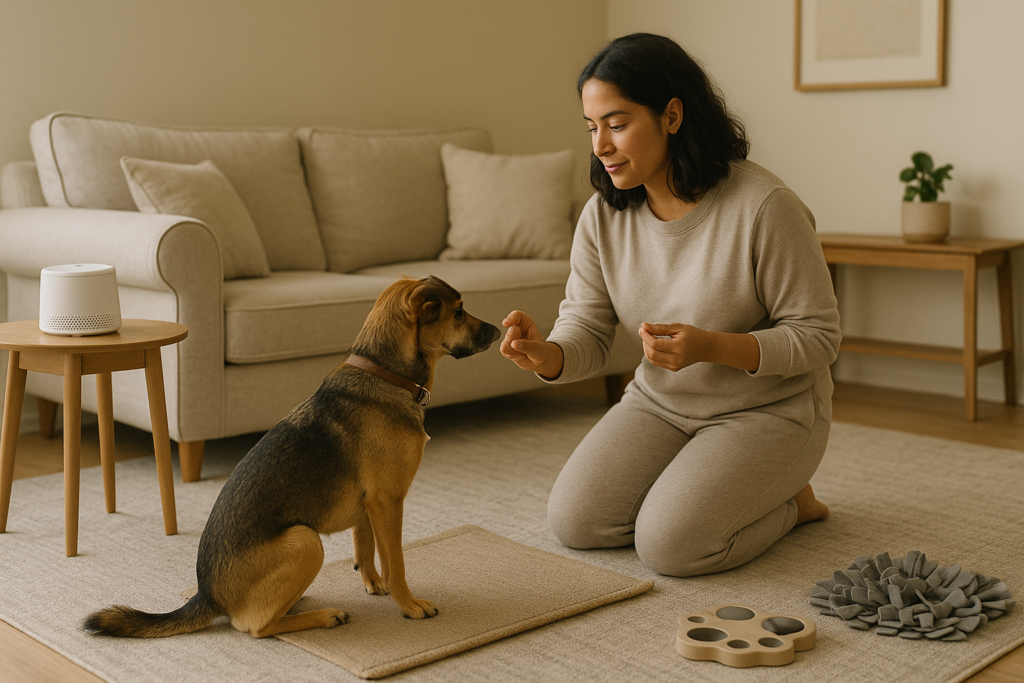

A Clear, Humane Training Plan for Reducing Barking
Each dog barks for a different reason, and each training method works best when you match it to the type of barking you’re dealing with. This page gives you a complete, easy-to-follow plan that brings together everything you’ve learned so far: quiet cue training, redirection, environmental management, desensitization and counterconditioning (DS/CC), positive reinforcement, and the engage–disengage method.
You don’t need to use all the techniques at once.
You just need the right ones for your dog, used in the right order, in a simple, consistent routine.
This guide shows you exactly how to do that.
⭐ 1. Identify Your Dog’s Main Barking Type
Before training can be effective, it’s essential to understand why your dog is barking.
Dogs bark for emotional reasons, not because they’re “trying to misbehave.”
Use this quick guide:
Territorial/Protective Barking
Dog barks at: people, dogs, cars, noises outside, door, yard boundaries.
Fear-Based Barking
Dog barks when: startled, scared, uncertain, anxious, overwhelmed.
Boredom / Excess Energy Barking
Dog barks when: restless, understimulated, needs a job or activity.
Attention-Seeking Barking
Dog barks to: initiate play, get treats, get let outside, get petting, get your attention.
Separation Anxiety Barking
Dog barks while alone, during departures, or anticipates you leaving.
Knowing your dog’s main barking type helps you choose the right tools.
⭐ 2. Choose the Correct Training Method for Your Dog’s Barking Type
Here’s a simple matching guide you can refer back to.
Best Method for TERRITORIAL Barking:
- Quiet Cue Method
- Engage–Disengage Method
- Environmental Management
- Positive Reinforcement
Goal: reduce arousal and teach calm noticing.
Best Method for FEAR-BASED Barking:
- Desensitization & Counterconditioning (DS/CC)
- Environmental Management
- Positive Reinforcement
Goal: change the dog’s emotional response.
Best Method for BOREDOM / EXCESS ENERGY Barking:
- Redirection Training (“Do this instead.”)
- Exercise Management
- Enrichment Strategies
- Positive Reinforcement
Goal: give the dog something better to do.
Best Method for ATTENTION-SEEKING Barking:
- Positive Reinforcement of quiet
- Ignoring unwanted behavior (strategically)
- Redirection
- Predictable routines
Goal: reinforce calm, quiet behaviors that earn attention.
Best Method for SEPARATION ANXIETY Barking:
- DS/CC tailored to absences
- Environmental management
- Very structured alone-time training
- Professional guidance for moderate/severe cases
Goal: build emotional safety when the owner is away.
⭐ 3. Build a Simple, Consistent Training Structure
You don’t need complex drills or hour-long sessions.
Dogs learn best through short, frequent, calm training moments.
Below is an easy daily routine any household can use.
⭐ Morning Routine (5–10 minutes)
✔ Quick Training Practice
Choose 1–2 skills relevant to your dog’s barking type:
- “Quiet” cue practice
- Redirection (“Touch,” “Sit,” “Go to mat”)
- Controlled engage–disengage at low intensity
- Short DS/CC exposure at very low level
- Calm positive reinforcement for resting quietly
Keep these sessions light and successful.
✔ Predictable Activity
Follow with:
- A calm walk
- A sniffing session
- A puzzle feeder breakfast
This lowers energy and improves learning for the rest of the day.

⭐ Afternoon Routine (3–5 minutes)
✔ Training During Mild Triggers
This is the ideal time for:
- A structured redirection
- Engage–disengage practice
- Rewarding spontaneous quiet
- Controlled window work (if appropriate)
- Practicing “go to mat” with routine knocks or sounds
These short micro-sessions build real-world reliability.
✔ Enrichment Time
Offer a:
- Frozen Kong
- Snuffle mat
- Puzzle toy
- Chew item
- Scent activity
Enrichment prevents boredom-based barking.
⭐ Evening Routine (5–10 minutes)
✔ Consolidation Session
Reinforce everything learned earlier:
- Quiet cue with 2–3 repetitions
- Redirect-based play
- Practice staying calm during door-related scenarios
- DS/CC with low-level evening noises
- Short engage–disengage for outdoor triggers
✔ Settle Time
Evenings often have:
- More deliveries
- More dog-walkers
- More household activity
Environmental management is especially important here:
- Close blinds
- Add soft background sound
- Provide a cozy resting space
- Expect calmer behaviors
⭐ 4. Use “Calmness First” Environmental Management
Training only works when the dog is regulated.
Use these management strategies:
- Close blinds during peak activity
- Add white noise or music
- Block access to overstimulating windows
- Use a baby gate near the door
- Provide chew items or calming enrichment
- Create predictable routines
- Add light exercise (walks, fetch, sniffing)
- Allow structured rest periods
This keeps barking from spiraling.
⭐ 5. Reinforce Calm Behavior All Day Long
This is the secret.
Quietness must be rewarded just as consistently as barking used to be.
Reward:
- Resting quietly
- Looking out the window without reacting
- Checking in calmly
- Sitting politely when someone arrives
- Settling near you
- Quiet moments during excitement
- Pauses between barks
These tiny moments build strong habits.
⭐ 6. Address Triggers Systematically (Not All At Once)
Choose one high-priority barking trigger (or category of trigger) to work on first.
Examples:
- Doorbell
- People outside
- Other dogs
- Noises
- Visitors
- Being left alone
- Household activity
Focus on reducing arousal around that one trigger.
Once your dog is improving reliably, move to the next.
Trying to fix everything at once overwhelms both dog and human.
⭐ 7. Expect Ups and Downs (Progress Is Not Linear)
Dogs are emotional animals.
Just like people, their progress has natural fluctuations.
Common reasons barking may temporarily increase:
- New triggers
- Guests
- Weather changes
- Hormonal shifts
- Developmental stages (especially 6–18 months)
- Overstimulation
- Under-exercise
- Big life changes
These small regressions are normal.
Stay consistent.
Training results return quickly once routines resume.
⭐ 8. A Simple Weekly Training Plan (Sample)
Monday:
Quiet cue practice + window management
Tuesday:
Redirection + enrichment activities
Wednesday:
DS/CC with small, controlled triggers
Thursday:
Engage–disengage on walks
Friday:
Doorbell practice + mat training
Saturday:
Outdoor calmness (parks, sidewalks, low triggers)
Sunday:
Rest day
(No structured training; normal life with extra calmness)
⭐ 9. When to Seek a Professional Behaviorist
It’s appropriate to reach out for help if your dog shows:
- Panic during triggers
- Lunging with fear
- Aggression
- Biting or nipping
- Extreme separation anxiety
- Loss of sleep from hypervigilance
- Difficulty calming down
- Barking episodes that escalate quickly
- Sudden regression without clear cause
Professionals can help refine your plan and tailor it to your dog’s emotional needs.
⭐ 10. The Heart of the Plan: Understanding + Consistency
When owners approach barking with:
- Patience
- Clarity
- Humane methods
- Structure
- Predictability
- Calmness
- Reinforcement of the right behaviors
Dogs learn quickly.
Not perfectly—but beautifully.
You’re not just training quiet behavior.
You’re helping your dog feel safer, calmer, and more confident in the world around them.
TL;DR: Your Simple Barking-Reduction Training Plan
- Identify your dog’s main barking type before choosing a method.
- Match the right training technique to the specific reason your dog is barking.
- Use short, calm, consistent daily routines instead of long training sessions.
- Support training with strong environmental management to keep your dog under threshold.
- Reward calm behavior throughout the day — this is what builds lasting habits.
- Work on one trigger at a time to avoid overwhelming your dog.
- Progress isn’t linear; expect ups and downs and adjust routines as needed.
Frequently Asked Questions
Do I need to use every training method?
No. You only need the techniques that match your dog’s barking type. Using too many at once can create confusion and slow progress.
How long until I see improvement?
Most dogs improve within 1–3 weeks of consistent routines. Dogs with fear-based or separation-related barking may take longer but still show steady progress.
What if my dog gets worse before getting better?
Small regressions are normal. Dogs have emotional ups and downs just like humans. Stay calm and stick to your routine.
When should I get professional help?
If your dog shows panic, aggression, escalating fear, intense separation anxiety, or if barking disrupts sleep or daily life, a certified behavior professional can help tailor a plan.
Explore More Training Resources
Visit the full training library for downloadable guides, tools, and step-by-step methods:
See all scientific sources, studies, and recommended reading:
Continue Learning Humane Training Methods
- Positive Reinforcement Training
- Desensitization & Counterconditioning
- The Quiet Cue Method
- Engage–Disengage Method
- Redirection Training
- Environmental Management
- Outdated or Harmful Methods to Avoid