
Some dogs bark not out of fear, stress, or territorial instinct…but simply to get your attention.
This type of barking is often misunderstood, but the truth is simple:
Your dog has learned that barking = interaction.
Even negative interaction (“Stop it!”) is still interaction.
Attention-seeking barkers are not “bad dogs.”
They are dogs who have learned a very effective communication strategy — and with a few calm adjustments, you can teach them a new one.
What Attention-Seeking Barking Looks Like
Common signs include:
- Barking while staring directly at you
- Barking when you stop petting them
- Barking during mealtime or food prep
- Barking when you’re on the phone or computer
- Barking to demand play, toys, or treats
- Barking when you stop engaging with them
- “Bossy barking” paired with pawing or nudging
This barking is usually persistent but not fearful — it’s your dog saying:
“Hello? Pay attention to me now.”
Why Dogs Bark for Attention
1. It Works Every Time
Dogs repeat behaviors that get results.
If barking has caused you to look at them, talk to them, touch them, or do anything in response…
…your dog has learned the pattern.
2. Dogs Crave Predictable Social Interaction
Dogs are deeply social animals.
If their routine lacks:
- mental stimulation
- physical exercise
- calming structure
- one-on-one time
…they will try to create their own.
Barking is their version of tapping you on the shoulder.
3. They Get Bored Easily
Dogs that aren’t mentally enriched will naturally seek engagement.
This is especially true of:
- herding breeds
- retriever mixes
- puppies
- high-drive dogs
- smart dogs (border collies, poodles, shepherds)
4. You’re Accidentally Reinforcing It
You might not think you’re rewarding the barking, but if your dog barks and you:
- talk
- look
- sigh
- gesture
- push them away
- say “no”
- give a treat to shut them up
…you are reinforcing the behavior.

How to Gently Reduce Attention-Seeking Barking
Below are humane, effective steps that retrain your dog to ask for attention calmly.
1. Reward Quiet Behavior — Do NOT Reward Barking
This is the foundation.
The rule:
Quiet → reward
Barking → nothing
This means:
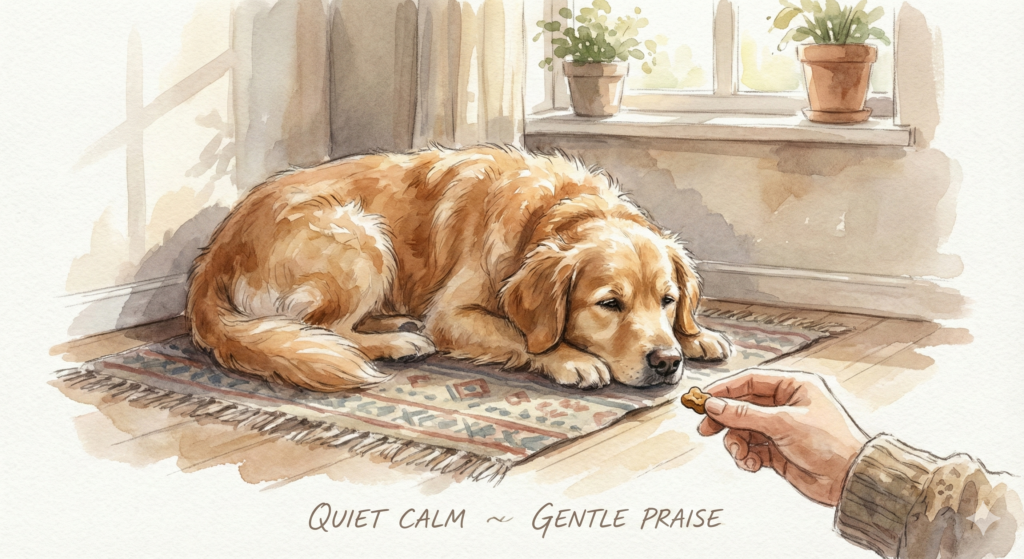
- When your dog is quiet and relaxed → calm praise or treat
- When your dog barks at you for attention → no eye contact, no talking, no reaction
This feels counterintuitive, but it works fast.
2. Teach a Simple “Settle” Cue
A “settle” routine gives your dog a job to do instead of barking.
How to teach it:
- Choose a spot (bed, mat, blanket).
- When your dog lies down calmly, reward it.
- Add the cue “settle.”
- Practice for 1–2 minutes at a time.
- Slowly introduce mild distractions.
Eventually, your dog learns:
Quiet + calm posture = attention and rewards.
3. Use Planned Attention Times
Dogs LOVE structure.
Add 2–3 intentional “attention blocks” each day:
- 5 minutes of training
- 10 minutes of toy play
- Afternoon enrichment time
- Evening cuddle time
If your dog knows attention is coming, they stop demanding it constantly.
4. Increase Enrichment and Mental Stimulation
Most attention barkers are mentally under-stimulated.
Add:
- puzzle feeders
- snuffle mats
- lick mats
- stuffed Kongs
- scent games
- basic obedience refreshers
- hide-and-seek treats
These take the place of barking as a dopamine source.
5. Teach an Alternate Behavior (“Do This Instead”)
Choose a replacement behavior that’s incompatible with barking, such as:
- bring a toy
- lie on a mat
- sit politely
- go to a specific spot
Then reward THAT behavior consistently.
The message becomes:
“Ask politely, not loudly.”
6. Avoid These Common Mistakes
❌ Giving treats during barking
Reinforces noise.
❌ Talking to the dog while they’re barking
Even “no” is attention.
❌ Yelling
Some dogs interpret this as “bark WITH me!”
❌ Giving up too early
This behavior changes quickly — but only with consistency.
When Attention Barking Is Actually a Sign of Something Else
Sometimes what looks like attention-seeking is really:
- anxiety
- lack of exercise
- under-stimulation
- frustration
- confusion
- separation-related stress
- medical pain
If barking happens during certain activities (eating, resting, grooming), a vet check is wise.
FAQ: Attention-Seeking Barking
Why does my dog bark at me when I stop petting them?
Because it worked before. If a bark got your hand moving once, they’ll try it again. Teach calm alternatives like “settle” or “sit politely.”
Should I ignore attention-seeking barking completely?
Ignore the barking — but reward the quiet moments. The contrast teaches your dog what earns attention.
Will my dog bark more at first if I stop reacting?
Yes. This is called an “extinction burst.” Stay consistent and it stops quickly.
Is attention barking the same as separation anxiety?
No. Attention barking happens when you’re present.
Separation anxiety happens when you’re gone.
My dog barks while I’m working — what can I do?
Add scheduled attention breaks and give them enrichment toys during your focus blocks.
TL;DR: Why Dogs Bark to Get Your Attention
Attention-seeking barking happens when your dog learns that barking gets a response — even negative attention. With calm consistency, you can teach your dog quieter ways to ask for interaction.
- Dogs bark for attention because it works.
- Any reaction — talking, looking, sighing — reinforces the barking.
- Rewarding quiet behavior teaches calmer communication.
- Short, scheduled attention times reduce constant demands.
- Enrichment and training lower mental frustration.
Most dogs improve quickly once they learn that quiet earns attention — not barking.
Looking for the research behind these recommendations? See our full Citations & Sources page →