
Why Dogs Bark When They’re Excited — and How to Gently Encourage Calm Greetings
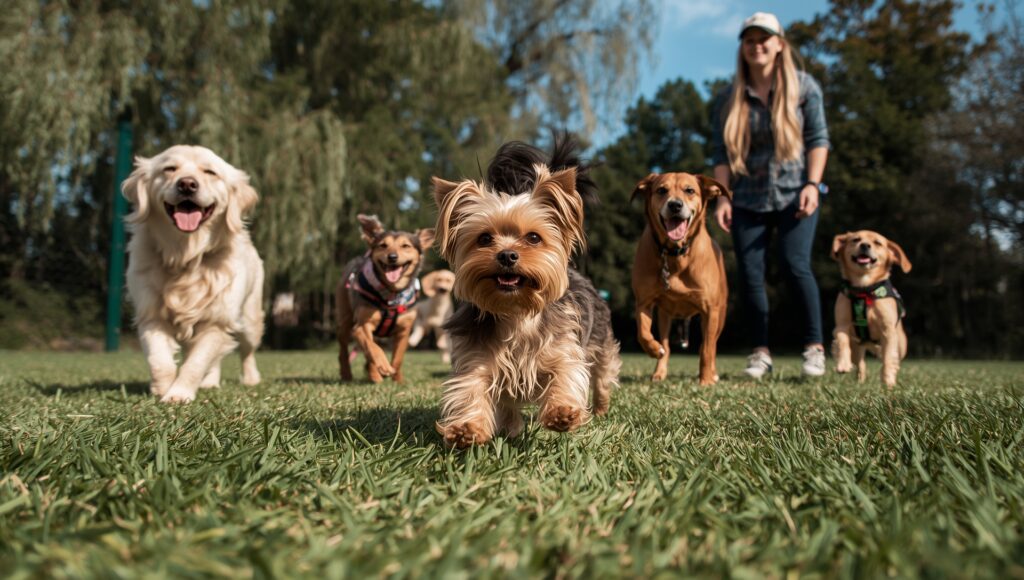
Play and greeting barking is one of the most common — and one of the most misunderstood — types of barking. Unlike territorial or fear-based barking, this isn’t about warning, stress, or protection. This barking comes from pure excitement, anticipation, and social joy.
Dogs bark when they can’t contain their enthusiasm: someone walks in the door, a friend arrives, the leash comes out, or a familiar dog appears across the street. It’s happy barking… but it can be loud, chaotic, and overwhelming in daily life.
This guide breaks down why it happens and how to teach calm greetings without suppressing your dog’s natural personality.
What Play & Greeting Barking Looks Like
Common signs include:
- Barking when you walk through the door
- Barking when visitors arrive
- Barking when meeting dogs on walks
- Excited vocalizing during play (bounce-barking)
- Barking when the leash comes out
- Barking during fetch, tug, or chase games
- Barking when anticipating a fun activity
- Barking while jumping up or play-bowing
This type of barking is usually accompanied by high-energy body language:
- Loose, wiggly body
- Wagging tail (often fast or circular)
- Play bows
- Spinning, hopping, or pacing
- Attempting to run toward the person or dog
- Grinning/open-mouth panting
- Ears relaxed or perked with curiosity
This energy is not aggression — it’s excitement paired with low impulse control.
Why Dogs Bark When Greeting or Playing
1. Social excitement spills over into vocalizing
Dogs communicate with body language first — but when arousal gets high, barking becomes a way to release energy.
2. Greeting rituals are deeply instinctual
Dogs greet through sniffing, movement, and vocalization. Many domestic dogs add barking simply because they’re pumped.
3. Anticipation heightens arousal
Reaching for the leash, opening the closet, hearing a car pull in — all of these become cues that “fun is about to happen,” which cues barking.
4. Greeting barking often gets accidentally reinforced
For example:
- You walk in → dog barks → you talk to them
- Visitor arrives → dog barks → attention happens
- Leash comes out → dog barks → walk happens
From the dog’s perspective, barking made the good thing occur.
5. Some breeds are naturally more vocal
Herding dogs, working dogs, terriers, retrievers, and many small companion breeds are especially prone to celebratory barking.
6. Lack of impulse control
Excitement isn’t the problem — regulation is.
Training focuses on building calm first, then greeting second.
How to Reduce Play & Greeting Barking (Gently and Effectively)
This isn’t about shutting down joy. It’s about creating a calmer, more controlled greeting ritual your dog can follow every time.
Below are the most effective, humane techniques.
1. Teach a “Calm Greeting” Routine
Dogs thrive on predictable patterns. Instead of reacting randomly, they learn to follow a simple sequence:
- Door opens
- Dog backs up or sits
- Calm body language = greeting allowed
- Excitable barking = momentary pause
This teaches:
“Calm makes the good thing happen.”
To train this:
- Practice with low-stakes greetings (no visitors yet).
- Enter the house quietly.
- If the dog barks or jumps, freeze briefly — don’t scold, don’t turn away dramatically.
- When the barking stops for even one second, mark the calm moment with “Good.”
- Step forward and greet.
- If barking restarts, pause again.
Dozens of tiny reps build the new motor pattern.
2. Reward “Four On The Floor”
Dogs bark MOST when their body energy is lifted off the ground.
Rewarding four paws on the floor quickly reduces:
- Greeting barking
- Jumping
- Spinning
- Door-chaos
Every time the dog stays grounded during excitement, drop a treat directly to the floor. This anchors the behavior.
3. Train a “Go to Mat” for Door Excitement
This is one of the most powerful tools for greeting control.
Steps:
1. Place a mat 5–10 feet from the door.
2. Practice sending the dog to the mat for treats (10–20 repetitions).
3. Add in light door triggers:
- Touching the doorknob
- Opening the door a crack
- Walking in from outside
4. Reward only when your dog stays on the mat and quiet.
5. Slowly increase intensity:
- Friend outside
- Real arrival
- Multiple people entering
Eventually the mat becomes a cue for:
“Go here and relax.”
4. Keep Greetings Small and Neutral (Humans Need Training Too)
Most visitors accidentally make things worse by:
- Talking high-pitched
- Reaching down fast
- Bending over the dog
- Exciting the dog with “Hiiii!! Oh my gosh!”
Ask people to follow a simple rule:
“Walk in. Ignore the dog. Let them sniff. Greet calmly after 10–15 seconds.”
Most dogs bark far less when humans stay low-energy.
5. Reduce Anticipation Triggers
If your dog barks when you:
- Pick up the leash
- Put on shoes
- Grab keys
- Walk toward the door
- Say “Want to go outside?”
Then the sequence has become a bark cue.
Break the pattern by:
1. Picking up the leash randomly throughout the day
(even when you’re not leaving)
2. Putting shoes on and sitting down again
3. Grabbing keys and then cooking dinner
4. Saying walk-related words out of context
This is called desensitization — it strips the triggers of their power.
When the real walk happens, your dog won’t explode with barking.
6. Channel Play Barking Into a “Quiet Cue”
Some dogs bark during play simply because they’re having a blast.
This isn’t misbehavior.
But if it becomes too much:
Try pattern interrupt + redirect:
- Pause the game for 3 seconds
- Say “quiet” in a soft, neutral voice
- When barking stops, even briefly, mark with “Yes.”
- Resume play immediately
This teaches:
“Quiet = play continues.”
Avoid harsh corrections — it damages trust and can reduce the joy of play.
7. Play More Low-Arousal Games
High-arousal games = more barking:
- Fetch
- Chase
- Tug-of-war
- Spring-pole
- Fast running
Low-arousal games = calmer vocal patterns:
- Scent games
- Puzzle toys
- Slow-pattern fetch (throw → sit → release)
- Flirt pole with structured intervals
- Snuffle mats
- Hide-and-seek
- “Find it!” treat tosses
If you balance both types, barking naturally reduces.
8. Practice Calm Arrival Rituals
This is a game-changer for home greetings.
Before entering the house:
- Take a slow breath
- Stand quietly for a moment
- Enter without speaking
- Don’t greet right away
- Put down your things
- Let the dog adjust to your arrival
- Then offer a calm greeting
After a few days, your dog will stop barking at the door entirely.
Dogs mirror your energy — if you enter calm, they greet calm.
Troubleshooting: When Play & Greeting Barking Doesn’t Improve
1. The dog is getting too little exercise
Many dogs bark from pent-up energy.
A 10-minute walk is not enough — they need physical and mental work.
2. The dog is overstimulated daily
Constant high-intensity play can create a “barking factory.”
3. Inconsistent human behavior
If one family member reinforces barking while another trains calm greetings, the dog gets confused.
4. Greeting is happening too quickly
Slow everything down.
Add 3–10 seconds of “pause time” before greeting.
5. The dog struggles with impulse control
Practice micro-exercises:
- Sit → reward
- Wait → reward
- Down → reward
- Touch/hand-target → reward
- Leave it → reward
These build the brain skills needed for calm greetings.
When Play/Greeting Barking Is Normal vs. When It Isn’t
Normal
- A few barks when someone arrives
- Brief excitement barking during play
- A bark or two during leash time
- A quick vocal burst from anticipation
Not normal / needs attention
- Barking lasts more than 2–3 minutes
- Barking escalates into frantic jumping or mouthing
- The dog can’t calm down even after the greeting
- The dog barks at every tiny noise
If it feels out of control, training is essential — but the fix is still gentle, not punitive.
Quick Summary: How to Reduce Play & Greeting Barking
- Teach a predictable greeting routine
- Reward four paws on the floor
- Train a go-to-mat behavior
- Reduce human excitement
- Desensitize anticipation triggers
- Use the quiet cue during play interruptions
- Add low-arousal games
- Slow down arrival rituals
- Practice tiny impulse-control exercises daily
This combination works for 90% of dogs within 2–4 weeks.
FAQ: Play & Greeting Barking
Why does my dog bark when I pick up the leash even if we’re not going for a walk?
Many dogs learn that the leash predicts a fun activity, so picking it up becomes an excitement trigger. This anticipation leads to barking because the dog expects a walk to happen next.
How do I teach my dog to greet people calmly instead of barking?
Use a simple calm-greeting routine: ask your dog to sit or back up when the door opens, pause when they bark, and greet only when they show calm body language. This teaches that calm behavior—not barking—leads to attention.
Is greeting barking normal or a sign of a problem?
A few excited barks during greetings are normal. It becomes an issue if barking is intense, lasts several minutes, or your dog can’t settle after the greeting. In those cases, calming routines and impulse-control training are helpful.
Can play barking be reduced without stopping play?
Yes. You can reduce play barking by briefly pausing the game, waiting for a moment of quiet, and then resuming play. This teaches your dog that quiet behavior keeps the fun going while still allowing joyful play.
TL;DR
Play and greeting barking happens when dogs get excited, social, or anticipate something fun — not because they’re anxious or aggressive. Calm greetings improve when you build predictable routines, reward four paws on the floor, teach a “go to mat” behavior, and reduce human excitement during arrivals. Desensitizing triggers like leashes, keys, and walk cues lowers anticipation barking. During play, use short pauses and quiet cues to gently reduce excess barking while keeping the joy intact.